Gulf Stock Market Crash! Your Job at Risk? This can save you.
Here’s what professionals need to watch—not fear.
The New Tariff
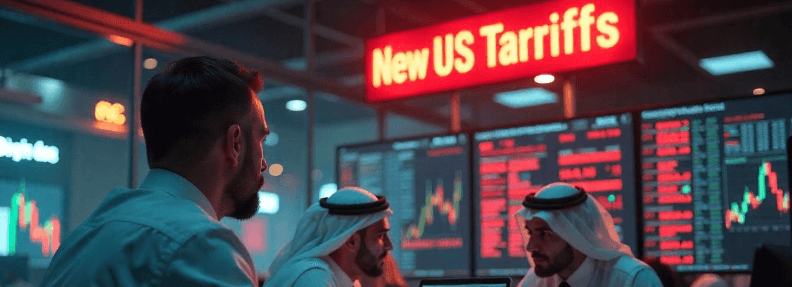
The exemption of oil from U.S. tariffs has been widely noted, but less discussed are the indirect tremors being felt across GCC economies. In early April 2024, a 10% tariff was imposed on imports from all six GCC nations, sparking renewed scrutiny of the region’s non-oil sectors. Market analysts are now questioning whether these sectors—which contribute to the GCC’s GDP—could face prolonged headwinds in the months ahead. What is being observed, and how might this shape your professional landscape?
Rising Concerns
1. Non-Oil Sectors: Emerging Concerns
- Construction & Logistics:
- Market observers suggest that tariffs on materials like steel could strain operational budgets for construction firms, potentially delaying high-profile projects. In logistics, re-export hubs are reportedly bracing for tighter margins as trade dynamics evolve.
- Dubai’s re-export sector, a linchpin of its economy, is said to be exploring alternative markets to counterbalance reduced US-bound activity.
- Consumer Goods & Inflation:
The GCC’s dollar-pegged currencies are under discussion for their role in amplifying imported inflation. Reports hint at rising prices for everyday goods, though official data continues to emphasize macroeconomic stability.
2. Job Security in Focus: Risks and Pathways
If trade tensions escalate further, tighter corporate margins could fuel recessionary anxieties, with hiring slowdowns and layoffs becoming a possibility. Inflationary pressures, if sustained, might erode purchasing power, creating additional strain for households. However, this narrative isn’t set in stone—it’s a call to action.
Shifting to Solutions:
- Emerging Sectors as Lifelines:
While traditional sectors face headwinds, renewables, AI, and healthcare are increasingly seen as recession-proof. GCC governments are fast-tracking investments in these areas, creating roles in solar engineering, data analytics, and telemedicine.
- Upskilling as Insurance:
Professionals who pivot to certifications in AI, green energy, or digital marketing may find themselves insulated from broader market volatility. Employers increasingly value agility—those who adapt could even command premium salaries.
3. Market Sentiments: What Analysts Are Saying
- Localization Efforts:
Vision 2030 initiatives are frequently cited as a stabilizing force, with GCC nations focusing on domestic production earning cautious optimism. Similar efforts in the UAE to bolster manufacturing are seen as steps toward long-term resilience.
4. Long-Term Outlook: Predictability Over Panic
- Sovereign Wealth & Diversification:
The GCC’s sovereign wealth reserves are widely regarded as a buffer against external shocks, with diversification strategies expected to soften the impact of trade disruptions. Renewables and tech investments, in particular, are viewed as pivotal to future-proofing economies.
- Adaptability as a Theme:
While short-term adjustments are anticipated, the broader narrative leans toward resilience. Upskilling and sectoral agility are repeatedly emphasized as strategies to navigate uncertainties.
Path Ahead...
Though uncertainties linger, the GCC’s strategic investments and diversification efforts are fostering a sense of cautious optimism. For professionals, staying attuned to sectoral trends—rather than reacting to short-term noise—may prove most prudent.
Your Role in the Story:
- If risks materialize: View this as a nudge to future-proof your skills.
- If stability holds: Leverage growing sectors to advance your career.
Turn uncertainty into opportunity by visiting Naukrigulf.com. Stay tuned for more such insights on where the GCC job market is headed—so that you can stay ahead.
Related articles
NEW
Why your job search is taking longer than it should?
You have updated your CV. You are applying regularly. You are qualified for the roles you are targeting. And still nothing. W...
Read more
NEW
The follow up: Why most jobseekers get this wrong?
We asked professionals how many applications they send before expecting a single response. The most common answer, chosen by ...
Read more
NEW
UAE launches AED 1 billion industrial fund: Make it in the Emirates hits record
The UAE just made its most significant industrial investment commitment of 2026 and the scale of it matters for anyone thinki...
Read more