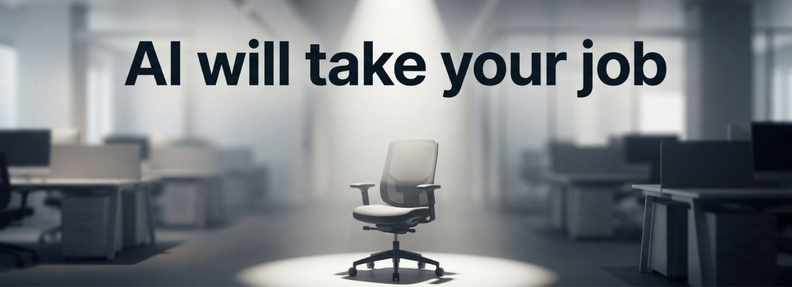
Is AI actually taking jobs — or is that just fear?
One colleague tells you AI is coming for everyone. Another says it is all hype. Your manager mentions "efficiency" in a meeting and the room goes quiet. So what is really happening — and what does it mean for you?
Let us look at both sides honestly.
Table of contents
- The case for concern — and it is real
- The case for perspective — and it is equally real
- So which is it — fear or fact?
The case for concern — and it is real
The anxiety is not imaginary. According to the PwC Middle East Workforce Hopes and Fears Survey 2025, 85% of the regional workforce say job security is a top priority when considering new roles — six points higher than the global average of 79%. That gap tells you something: professionals here are paying close attention, and they are not entirely comfortable with what they see.
The structural shift behind that anxiety is real. The WEF Future of Jobs Report 2025 projects that by 2030, 45% of total work tasks in Saudi Arabia and 43% in the UAE will be delivered predominantly by autonomous technologies. Nearly half of all daily work — automated.
If your role is built around repetitive processing — data entry, routine reporting, standard customer queries, high-volume document handling — the honest answer is that your role is changing, and in some cases, it is shrinking.
Already know your role is changing? Here is your transition guide → Your role is being automated. Here is what to do next.
The case for perspective — and it is equally real
Here is what the same regional research also found — and what rarely makes it into the fear cycle.
According to PwC's Middle East Workforce Hopes and Fears Survey 2025, 87% of employees in the region report higher-quality work since AI entered their workflows. Eight in ten say it has actively improved their productivity.
That is not a fringe view. That is the majority experience of professionals working alongside AI right now, in this region.
What the data is actually describing is a workforce in transition — not in freefall. The tasks being automated are largely the predictable, rule-based ones. What remains, and what is becoming more valuable, is everything that requires judgement, relationships, and the ability to navigate complexity.
So which is it — fear or fact?
Both. That is the honest answer.
The fear is grounded — nearly half of daily work tasks across the region are projected to shift in the next five years. But the professionals reporting the sharpest anxiety are often not the ones already working with AI. They are the ones waiting for certainty before they move.
The data does not describe a labour market in collapse. It describes one in transition — and transition, handled early, is just another word for opportunity.
Related articles
Dubai is deploying AI across its private sector. What does that mean for your role?
The question is not whether AI will change your sector. It already is. The more useful question — the one that actually affects your next career decision — is how fast the change i...
Read more
Your role is being automated. Here is what to do next
You noticed it before anyone said anything out loud.A process that used to take your team a week now runs overnight. A task you spent years mastering gets done in minutes. The job ...
Read more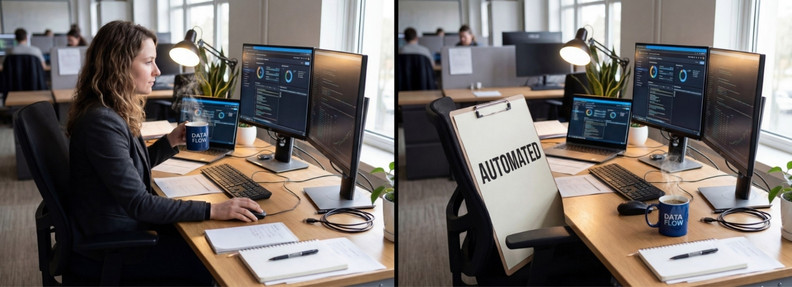
First week in a Gulf office: what no one tells you
The job offer is signed. The visa is sorted. You've found a place to stay. And then Sunday arrives.Most professionals who relocate to the Gulf say the same thing a few weeks in: se...
Read more