
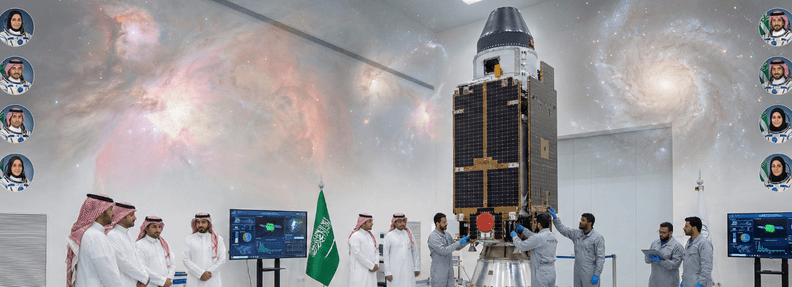
Saudi space economy to reach $31.6 billion by 2035: Career opportunities emerging
Table of Contents
- Saudi Arabia's space ambitions
- Impressive economic growth projections
- Key developments and initiatives
- The skills gap represents opportunity
- Emerging career pathways
- Government commitment and international collaboration
- Why now is critical for space careers
Saudi Arabia's space ambitions
Key objectives include developing satellite systems and technologies, monitoring and tracking space objects and debris, executing human exploration missions, and developing the capabilities of national cadres in all areas of the space sector. This aligns directly with Vision 2030 objectives of empowering people and investing in national energies in scientific and technical fields(1).
Impressive economic growth projections
The numbers demonstrate remarkable momentum. The communications, space, and technology commission announced that the Saudi space economy reached $8.7 billion last year, including all value-added activities and industries from space technologies and services(2). The size of the space market reached $1.9 billion, according to the "KSA Space Market 2025" report(2).
The projections are even more impressive. The Saudi space economy is expected to reach $31.6 billion in 2035, with a compound annual growth rate estimated at 12%(2). This growth rate exceeds the global benchmark, as the global space economy is expected to reach $1.8 trillion in 2035, recording a CAGR of 9%(2). Saudi Arabia is growing faster than the global average, demonstrating competitive positioning in this emerging sector.
Key developments and initiatives
Saudi Arabia is actively building its space capabilities through multiple initiatives. The Saudi space agency launched the "Knowledge Space" digital portal in October 2025 under the slogan "explore the horizons of the universe" to spread awareness and expand knowledge of space sciences(1).
The agency will host the second International Space Debris Conference in Riyadh on January 26-27, 2026(1), strengthening the Kingdom's leadership in global space sustainability initiatives. The conference includes the launch of the global debrisolver competition, generating innovative technical and regulatory solutions to address space debris challenges(1).
International collaboration is expanding rapidly. Saudi Arabia signed an agreement with NASA under the Artemis II mission to launch the Kingdom's first satellite dedicated to studying space weather(1). A memorandum of understanding with the Indian Department of Space aims to enhance cooperation in satellite capacity development, space sciences advancement, and practical application of space technologies(1).
Notable market developments include earth observation data analysis, infrastructure services, integrated communication systems, advanced sensing systems, and the development of small satellites(2).
The skills gap represents opportunity
Here's the reality that creates opportunity: while organizations in Saudi Arabia have made progress with space-based programs such as the Centre of Excellence for Aeronautics and Astronautics at KACST, a gap still exists between academic degrees and practical job skills(2). This makes it difficult for satellite companies to find local skilled talent in Saudi Arabia(2).
To tackle the lack of readily available local skilled talent, sponsored educational and training programs focusing on specific verticals in the satellite upstream and downstream market could train talent(2). Incubators which could nurture upcoming satellite companies (such as SARsat which won TAQADAM organized by KAUST) would be very helpful in promoting local talent in the space sector(2).
This gap is an opportunity. Those who develop space sector skills now will find themselves in high demand as the industry scales from $8.7 billion to $31.6 billion over the next decade.
Emerging career pathways
The expanding space sector creates diverse career opportunities. Satellite systems development and engineering roles are fundamental as the Kingdom builds its space infrastructure. Space debris monitoring and mitigation specialists will be increasingly valuable, particularly with Saudi Arabia positioning itself as a hub for space sustainability.
Earth observation data analysis, communication systems integration, and advanced sensing systems development represent growing technical specializations. Small satellite manufacturing is emerging as a key sector, offering opportunities in design, production, and testing.
The space academy initiative aims to develop national human capabilities in the space sector, providing leading-edge knowledge and insights for space exploration(1). This creates demand for educators, trainers, and curriculum developers who can transfer space knowledge to the next generation.
Space research and development roles span theoretical and applied sciences. Entrepreneurship opportunities exist through incubators supporting space startups, allowing innovative professionals to build companies in this growing ecosystem.
Government commitment and international collaboration
The royal decree establishing the agency demonstrates top-level government commitment to space sector development. International partnerships with NASA, S.Korea and India, combined with hosting global conferences like the Space Debris Conference, position Saudi Arabia as a regional hub for space cooperation(1).
The sector's global transformations include private sector entry, increasing demand for satellite-based services, and reignited interest in space exploration(2)—all trends that Saudi Arabia is actively embracing through policy and investment.
Vision 2030 backing ensures sustained investment over the coming years. These efforts contribute to achieving Saudi Vision 2030 goals and establishing a competitive, sustainable space economy both regionally and internationally(2).
Why now is critical for space careers
The timing creates unique advantages for professionals entering the space sector. An industry growing from $8.7 billion to $31.6 billion over the next decade represents a 12% annual growth rate—meaning rapid expansion and substantial job creation.
The current skills gap means early movers gain competitive advantage. As educational programs and incubators emerge, those who engage now will have years of experience by the time the sector fully matures. The government actively seeks to develop national talent, creating pathways for Saudi professionals to lead the sector's growth.
References
Related articles
NEW
The follow up: Why most jobseekers get this wrong
We asked professionals how many applications they send before expecting a single response. The most common answer, chosen by ...
Read more
NEW
Why your job search is taking longer than it should.
You have updated your CV. You are applying regularly. You are qualified for the roles you are targeting. And still nothing. W...
Read more
Dubai is deploying AI across its private sector. What does that mean for your role?
The question is not whether AI will change your sector. It already is. The more useful question — the one that actually affects your next career decision — is how fast the change i...
Read more