
Saudi tourism localizes jobs: 1.6 million opportunities by 2030
The policies, developed in collaboration with relevant government agencies, aim to increase citizens' contribution to the tourism sector and provide stimulating job opportunities, including leadership roles and positions for recent graduates, aligning with Saudi Vision 2030(1). This localization framework ensures Saudi nationals benefit directly from the Kingdom's rapid tourism expansion.
Table of Contents
- 1.6 million jobs target by 2030
- Flagship projects and driving authorities
- Achievements building strong foundation
- Global events amplifying growth
- Digital platforms enabling expansion
- The next 5 years: critical opportunity window
1.6 million jobs target by 2030
Tourism plays a crucial role in creating job opportunities for Saudi nationals, with initiatives aimed at training and employing citizens in hospitality, tour operations, and event management. The goal is to generate 1.6 million tourism-related jobs by 2030(2).
This employment target aligns with ambitious visitor goals. Saudi surpassed its vision 2030 tourism target seven years ahead of schedule, welcoming 100 million domestic and international visitors. The Kingdom has since raised the bar, setting a new goal of 150 million tourists by 2030(2). More visitors create exponential demand for tourism professionals across all subsectors—from front-line hospitality staff to specialized tour operators and event coordinators.
Flagship projects and driving authorities
The transformation is coordinated by key entities: the Ministry of Tourism, Saudi Tourism Authority and Tourism Development Fund work collaboratively under the national tourism strategy framework to ensure comprehensive sector development.
Major projects demonstrate the scale of opportunity. The Red Sea Project features a collection of world-class resorts, while AMAALA represents one of the red sea's luxury tourism destinations (2). Qiddiya, an entertainment, sports, and cultural megaproject, is expected to become one of the leading global destinations of its kind (2).
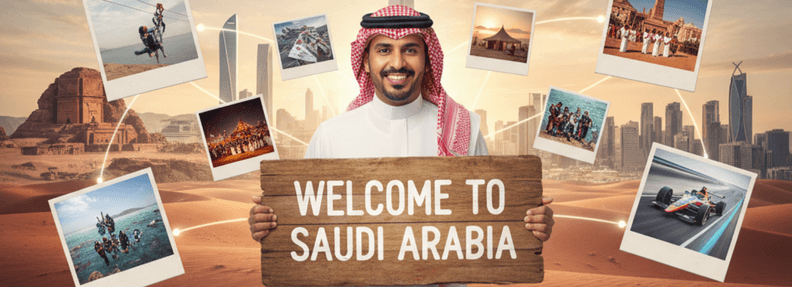
Experiences like desert hiking in AlUla, diving in the Red Sea, cultural festivals like winter at Tantora, and heritage tourism across Diriyah and Najran showcase the diversity of offerings available (2). Each project and destination creates thousands of employment opportunities across construction, operations, hospitality, and management roles.
Achievements building strong foundation
Recent accomplishments validate the Kingdom's tourism strategy and provide confidence for future growth. Saudi Arabia ranked first globally in tourism revenue growth for 2024 and led G20 countries with a 69% growth rate in international tourist numbers compared to 2019(3).
Riyadh was named one of the world's top 20 cities for food experiences by Time Magazine, while Madinah and AlUla were recognized among the world's top tourism destinations(3). Infrastructure development proceeds at scale, with over 230,000 hotel rooms planned to support the 2034 FIFA world cup, with 15 Saudi cities participating in hosting events(3).
These achievements represent proven capability that attracts further investment, creates sustained employment, and establishes Saudi Arabia as a serious global tourism player.
Global events amplifying growth
The Kingdom is set to host major global events including Expo 2030, FIFA world cup 2034, and the Esports world cup(2). These events reflect growing international confidence in the Kingdom and underscore its emergence as a dynamic and pioneering tourism hub(2).
Each event requires massive workforce deployment across multiple sectors—hospitality, transportation, event management, security, translation services, customer service, and technical support. The FIFA world cup alone, spanning 15 cities with over 230,000 hotel rooms, demonstrates the employment scale.
Digital platforms enabling expansion
Technology plays a crucial enabling role in Saudi's tourism transformation. Key initiatives include the launch of the VisitSaudi platform, introduction and expansion of the e-visa program to include 66 countries, and pilot launch of Sarah, the AI tourism assistant(3).
Digital platforms make Saudi more accessible to international visitors, directly driving tourist numbers upward. The e-visa expansion to 66 countries removes entry barriers, while the visit Saudi platform streamlines trip planning. Sarah, the AI assistant, showcases how technology enhances visitor experience while creating tech-related tourism jobs alongside traditional hospitality roles.
This digitization creates employment in areas like platform management, digital marketing, data analytics, customer support, and AI system development—expanding the definition of tourism careers beyond conventional roles.
The next 5 years: critical opportunity window
The coming years represent a critical period as government and stakeholders intensify efforts to achieve the 150 million visitor target. Tourism has emerged as a high-priority growth sector, with localization policies ensuring Saudi nationals capture maximum benefit from expansion.
Professionals entering the sector now will grow alongside the industry, gaining experience that positions them for leadership roles as tourism matures into a cornerstone of Saudi's diversified economy. The convergence of localization policies, flagship projects, global events, and digital platforms creates unprecedented opportunities for Saudi nationals. The next five years offer career possibilities that align national economic goals with individual professional growth.
References
Related articles
Dubai is deploying AI across its private sector. What does that mean for your role?
The question is not whether AI will change your sector. It already is. The more useful question — the one that actually affects your next career decision — is how fast the change i...
Read more
Your role is being automated. Here is what to do next
You noticed it before anyone said anything out loud.A process that used to take your team a week now runs overnight. A task you spent years mastering gets done in minutes. The job ...
Read more
Is AI actually taking jobs — or is that just fear?
Somewhere between the headlines and the coffee machine conversations, it has become very hard to know what is actually true.One colleague tells you AI is coming for everyone. Anoth...
Read more