
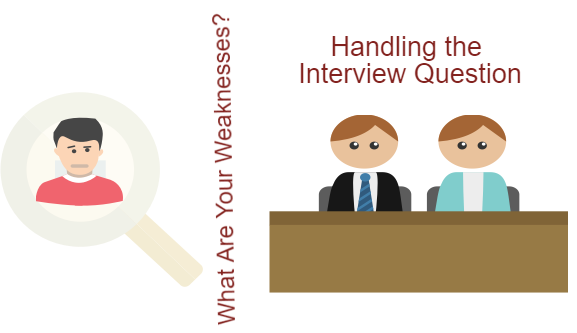
Answering the Interview Question: “What are Your Weaknesses”?
"What is your biggest weakness?" is the one interview question that looks like a nightmare to every job seeker. Obviously, it is not easy to tell the hiring manager about your weaknesses when you want to highlight everything good about you and get hired! But when asked, you surely can’t ignore this dreadful question and need to prepare it in advance.
Here’s the trick to answer this question.
But before finding an answer to this, you should first understand why the employer is asking it. The recruiter simply wants to gauge how much aware you are about your areas of improvement and how do you plan to overcome it. This reflects on you how confident you are to discuss not just your achievements and strengths, but also weaknesses, and how smartly you can hold yourself against any tough situation.
DENIAL!!!
Well, this is the biggest mistake that you could make.
Remember, everyone has at least one weakness, and even the employer also knows it well. Hence, the worst reply would be to say that, “I don’t have any weakness!”
So, it’s time to be honest, but in a way that doesn’t ruin your chances to get that job offer.
Here’s a two-step approach to handle this question:
- Confess your weakness
- Plan your recovery
Confess Your Weakness
The smart move is to find a weakness that is probably a strength in disguise or something that doesn’t directly impact your ability to get the job. For example,
“I feel my biggest weakness is that I am too dedicated to my work and I do not hesitate to give more than the required time to achieve perfection. This often takes a lot of my time, but gives 100% result!”
Plan Your Recovery
The recovery answer for such a weakness would be:
“But I understand that time-management is also equally important as achieving perfection, and therefore I am also concentrating on improving my time-management skills. Now I can see myself improving a lot, ensuring quality as well as efficiently in my work assignments.”
To support your action of overcoming your weakness, be prepared to quote certain examples how you are improving on your weakness, for instance, what kind of time management tips you are following.
Another Example:
Weakness: “I can’t see people around me unhappy. Therefore, I take extra pain to help people in their personal life or even at workplace, for which they might start taking me for granted. This on the other hand is also my strength as people love me for my caring nature.”
Recovery: “I am working on to recognize things that need to be done on priority, thus saving time for things that actually need me- - people or work!”
Giving such balanced answers, where you are aware about your weakness as well as the course of action, makes you look confident and practical.
Takeaway:
The simple trick to answer this scary interview question is to tell a weakness that has little or negligible impact on the job role offered. Also add how you are working to improve upon your weakness to secure your potential for the position.
In other words, start your answer with identifying the problem (the weakness) and ending with how you are fixing it (the recovery). So, you are almost ready to ace it!
Good luck.
Related articles
How to evaluate a company before you even apply?
Most jobseekers spend their energy getting companies to notice them. Fewer spend time asking whether the company deserves their application in the first place.In a market with thou...
Read more
Is your notice period hurting your job search?
You have the right experience.The job matches your skills.The interviewer is interested.Then comes one question:“How soon can you join?”You say two or three months, and suddenly th...
Read more
What should you do if your job search isn't working?
You have applied for dozens of jobs.Your CV is ready. Your profile is updated. You keep finding new openings and applying.But the interviews are not coming.Before sending another a...
Read more