
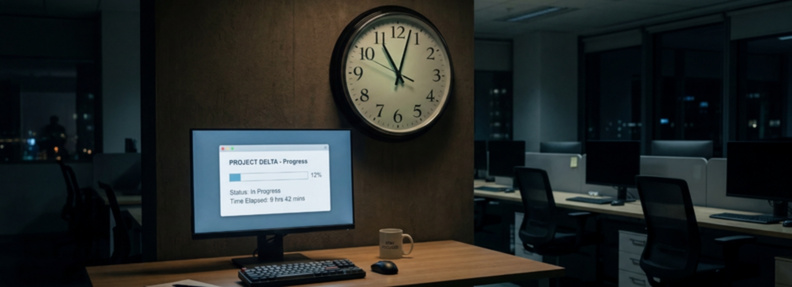
Working longer doesn’t mean working better
Long hours signal commitment. Late nights signal ambition. Being constantly busy signals productivity.
At least, that’s the perception.
But productivity doesn’t always follow the clock.
Some of the most effective professionals aren’t the ones working the longest hours — they’re the ones who focus their effort where it matters most. As workplace expectations continue to grow, the difference between working longer and working better is becoming increasingly important.
Table of contents
- Why hustle culture glorifies long hours
- When long hours start becoming a problem
- Why more hours don’t always improve performance
- Rethinking the hustle mindset
Why hustle culture glorifies long hours
Modern workplaces are evolving rapidly. New technologies, shifting priorities, and rising competition are pushing organizations to expect more from their teams.
According to PwC’s Workforce Hopes and Fears report, employees today are navigating rapidly changing expectations and increasing demands at work. Many professionals feel pressure to stay constantly responsive, adapt quickly, and demonstrate commitment through visible effort.
In this environment, long hours can easily become a signal of ambition.
Staying late, taking on additional tasks, and remaining constantly available often feels like the safest way to prove dedication—especially early in a career.
But visible effort doesn’t always translate into stronger results.
When long hours start becoming a problem
As expectations rise, so does the strain on employees.
According to Gallup’s State of the Global Workplace report, nearly half of employees in the Middle East and North Africa report experiencing significant stress during the workday.
Country-level figures provide additional context. The percentage of employees reporting daily stress stands at:
- Bahrain – 38%
- United Arab Emirates – 35%
- Kuwait – 32%
- Saudi Arabia – 28%
- Oman – 22%
Although these figures are lower than the broader regional average, they still show that a large share of professionals already experience daily workplace pressure.
As expectations, digital workflows, and competition continue to increase, these numbers could rise further.
When extended working hours are layered onto already demanding environments, energy and focus begin to decline. What looks like productivity can often mask fatigue, distraction, and reduced effectiveness.
The result is a culture where people work more — but not necessarily better.
Why more hours don’t always improve performance
Human focus and creativity have limits.
After long stretches of work, concentration drops and decision-making slows down. Tasks that should take an hour may take twice as long. Small mistakes become more frequent, and problem-solving becomes harder.
Over time, employees may spend more hours working while making less meaningful progress.
This is why productivity experts increasingly emphasize quality of work over quantity of hours.
Consistent performance rarely comes from simply working longer. It comes from maintaining focus, energy, and clarity over time.
Rethinking the hustle mindset
Hustle culture often celebrates constant activity.
But in reality, productivity isn’t defined by how long someone works — it’s defined by how effectively that time is used.
As workplaces evolve, more organizations are beginning to recognize the value of sustainable performance rather than constant hustle.
Because in the long run, working longer doesn’t always mean working better.
Related articles
Why are you getting more work but no promotion?
Your workload has doubled.You are handling bigger projects, helping new team members and taking on responsibilities that were never part of your original role.But your title has no...
Read more
How do you build a stronger career network at work?
You work with dozens of people.But if someone asked you tomorrow, “Who knows what you are good at?” would you have an answer?Your workplace network is not just the people you sit w...
Read more
Working with colleagues from 30 different countries in one office
Walk into most offices in the UAE or Qatar and you will hear three languages before you reach your desk. This is not unusual here. It is the norm.The region's workforce is one of t...
Read more